
Water management in oil and mining extractive operations is one of the most complex and consequential engineering challenges facing the extractive industry today. From open-pit copper mines in arid regions to offshore petroleum platforms and onshore drilling sites, the volumes of water involved — whether in process water, produced water, acid mine drainage, or stormwater runoff — demand rigorous hydrological and hydraulic planning. Companies that fail to implement sound water management frameworks risk regulatory penalties, operational shutdowns, environmental liabilities, and reputational damage that can affect their social license to operate for years. At EHMH Group, we work with industrial and infrastructure firms to design, assess, and optimize water management systems tailored to the specific demands of extractive operations.
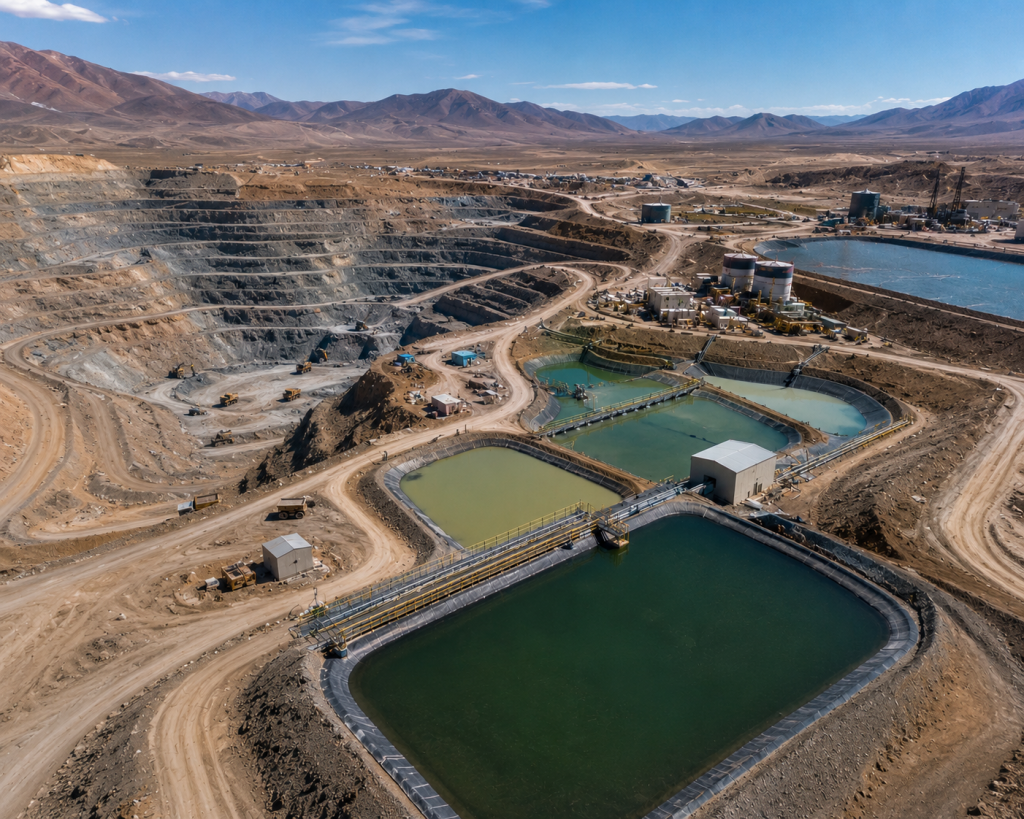
Prompt IA: AI image prompt: Aerial professional photograph of a large open-pit copper mine in an arid landscape, showing clearly delineated water diversion channels, a tailings storage facility with a containment berm, and a network of drainage ditches carved into reddish-brown terrain. The image should convey industrial scale, precise engineering infrastructure, and the challenge of managing water in an arid extractive environment. Overcast natural lighting, no people visible, photorealistic.
Nombre de archivo sugerido: water-management-open-pit-mining-extractive-operations.jpg
Título sugerido: Water Management Infrastructure at Open-Pit Mining Operation
Alt / leyenda sugerida: Aerial view of water management infrastructure at an open-pit mining operation showing diversion channels and tailings impoundment
The Core Water Challenges in Extractive Industries
Oil and mining operations generate and interact with water in fundamentally different ways than urban or agricultural contexts, but the stakes are equally high — and the regulatory scrutiny is significantly greater. Understanding the specific challenge typology is the starting point for any credible engineering solution.
Produced Water and Process Water in Petroleum Operations
In petroleum extraction, produced water — water that is trapped in underground formations and comes to the surface along with oil and gas — is the largest volume byproduct of hydrocarbon production globally. Managing its disposal, treatment, reinjection, or reuse requires detailed hydrological solutions that account for subsurface conditions, surface water proximity, and applicable discharge regulations. Injection wells, evaporation ponds, and water treatment facilities all need hydraulic design grounded in basin-level hydrology.
Acid Mine Drainage and Tailings Impoundments in Mining
In mining operations — whether metallic minerals, coal, or industrial minerals — the primary water risks include acid mine drainage (AMD) from sulfide-bearing waste rock, seepage from tailings storage facilities (TSFs), and uncontrolled stormwater interaction with mine workings. Tailings dam failures have become a global engineering and environmental crisis, and regulators in most jurisdictions now require detailed hydrological risk assessments before TSF approvals are granted or renewed. A failure to model peak inflow events, probable maximum precipitation (PMP), and downstream flood propagation is no longer professionally or legally acceptable.
Regulatory and Environmental Compliance Pressures
Extractive companies operating across Latin America, North America, and globally face increasingly stringent environmental frameworks governing water discharge, watershed protection, and hydrological impact assessment. Environmental impact assessments (EIAs) for new mine or oil field developments routinely require companies to demonstrate that their operations will not significantly alter downstream hydrology, contaminate surface or groundwater resources, or increase flood risk in adjacent communities.
In this context, hydrological and hydraulic studies are not optional add-ons — they are baseline requirements for permitting. These studies must characterize the existing hydrological regime, model the post-construction and operational footprint, and propose mitigation infrastructure such as diversion channels, retention ponds, sediment traps, and monitoring networks. The quality and technical rigor of these studies directly determines whether a project moves through the permitting process efficiently or faces objections that delay production timelines by months or years.
Beyond permitting, continuous compliance monitoring requires that companies maintain real-time data on discharge volumes, water quality parameters, and stormwater flows — especially during extreme precipitation events. Climate change is intensifying the frequency and severity of such events, making adaptive water management planning an operational priority, not just a regulatory checkbox.
Prompt IA: AI image prompt: Professional industrial photograph of a hydraulic engineer in a hard hat and high-visibility vest reviewing digital hydrological model outputs on a ruggedized tablet at an oil field site. Background shows well pads, secondary containment berms, and stormwater collection ponds under a partly cloudy sky. The scene communicates technical precision, field engineering, and water risk assessment in petroleum extractive operations. Photorealistic, natural daylight.
Nombre de archivo sugerido: hydrological-modeling-petroleum-extractive-water-management.jpg
Título sugerido: Hydrological Modeling Review at Petroleum Extraction Site
Alt / leyenda sugerida: Hydraulic engineer reviewing hydrological model data for water management at a petroleum extractive operation
Technical Components of an Effective Water Management Plan
A robust water management plan (WMP) for an extractive operation integrates multiple technical disciplines. At EHMH Group, our approach combines watershed-scale hydrology with site-level hydraulic engineering to deliver plans that are both technically defensible and operationally practical.
Hydrological Characterization of the Mine or Field Basin
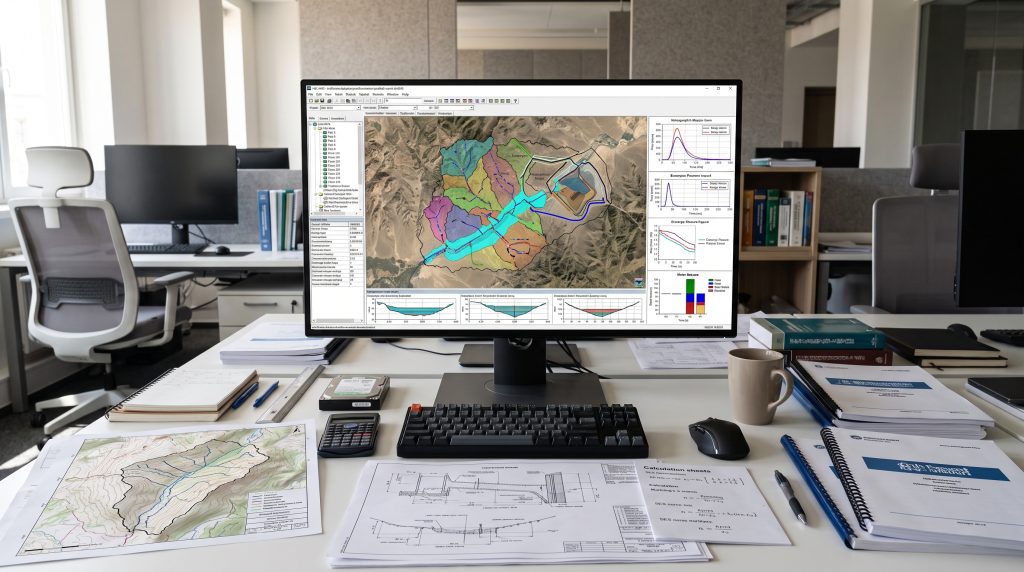
The foundation of any WMP is a comprehensive understanding of the watershed within which the operation sits. This includes delineating contributing drainage areas, characterizing precipitation regimes and return period rainfall events, estimating runoff generation using calibrated rainfall-runoff models, and mapping groundwater-surface water interactions. Our team applies industry-standard tools — including HEC-HMS, SWAT, and HEC-RAS — to build spatially accurate hydrological models that can be updated as operational conditions evolve over the mine or field life cycle.
Hydraulic Design of Water Control Infrastructure
Once the hydrological framework is established, the engineering team designs the physical infrastructure required to manage water safely. For mining operations, this typically includes perimeter diversion channels to intercept clean runoff before it contacts contaminated areas, drainage networks within the pit or processing plant footprint, spillways and emergency overflow structures for tailings impoundments, and sediment control basins. For petroleum operations, it includes produced water handling systems, stormwater collection around well pads, and secondary containment structures for spill response. All designs are hydraulically sized for the design storm event — often the 100-year or 200-year return period — with freeboard allowances for climate uncertainty.
Flood Risk and Downstream Impact Analysis
Extractive operations located in or near floodplains, river corridors, or steep mountain catchments face compound risks: the operation itself may alter natural flow regimes, and extreme events may threaten operational infrastructure. A formal flood risk analysis quantifies these threats and informs both the siting of critical infrastructure and the design of protective measures. This analysis is also essential for demonstrating to regulators and neighboring communities that the operation will not transfer flood risk downstream.
Strategic Water Reuse and Efficiency in Operations
Beyond risk management and compliance, forward-thinking extractive companies are increasingly viewing water as a strategic asset. In water-scarce regions — common in many of the world’s major mining districts, including the Atacama Desert, the Andes foothills, and arid regions of Australia and southern Africa — reducing freshwater intake is both an environmental imperative and a cost reduction opportunity. Process water recycling, treated effluent reuse for dust suppression or equipment cooling, and rainwater harvesting from large impervious surfaces (haul roads, processing plant roofs) can materially reduce the freshwater footprint of an operation.
Designing these systems requires the same hydrological rigor applied to risk management: understanding when and how much water is available, how demand fluctuates across operational phases, and how to store and distribute water reliably. EHMH Group has extensive experience applying these principles across industrial water systems, drawing on the same methodologies used in our work on hydraulic and hydrological engineering services for infrastructure and industrial clients.
Partnering with EHMH Group for Extractive Water Management
Effective water management in oil and mining extractive operations requires more than compliance checklists — it demands integrated engineering expertise, deep hydrological knowledge, and the ability to translate complex technical analysis into actionable infrastructure decisions. EHMH Group brings all of these capabilities to our clients in the extractive sector. Whether your operation needs a baseline hydrological study for a new project, a hydraulic audit of existing water control infrastructure, a tailings impoundment inflow design flood analysis, or a comprehensive water management plan for permitting, our team has the technical depth and industry experience to deliver.
We also support clients through the regulatory engagement process, preparing technical documentation that meets the standards expected by environmental authorities and independent reviewers. Our goal is to help your operation manage water responsibly, reduce hydrological risk, and maintain the operational continuity that your business depends on.
Ready to strengthen your operation’s water management framework? Contact EHMH Group today to speak with our hydrological and hydraulic engineering team about your specific operational context and requirements.