
For industrial companies operating in Argentina’s mining and hydrocarbon sectors, navigating the normativa ambiental de agua para minería e hidrocarburos en Argentina is not optional — it is a critical operational and legal requirement. Water use, discharge, and impact management are governed by a complex, multi-layered regulatory framework that spans national legislation, provincial jurisdiction, and international environmental standards. Failure to comply can result in project delays, regulatory sanctions, or the suspension of operational permits. This article outlines the key regulatory pillars that industrial and infrastructure companies must understand, and explains how specialized hydrological and hydraulic engineering supports full compliance.
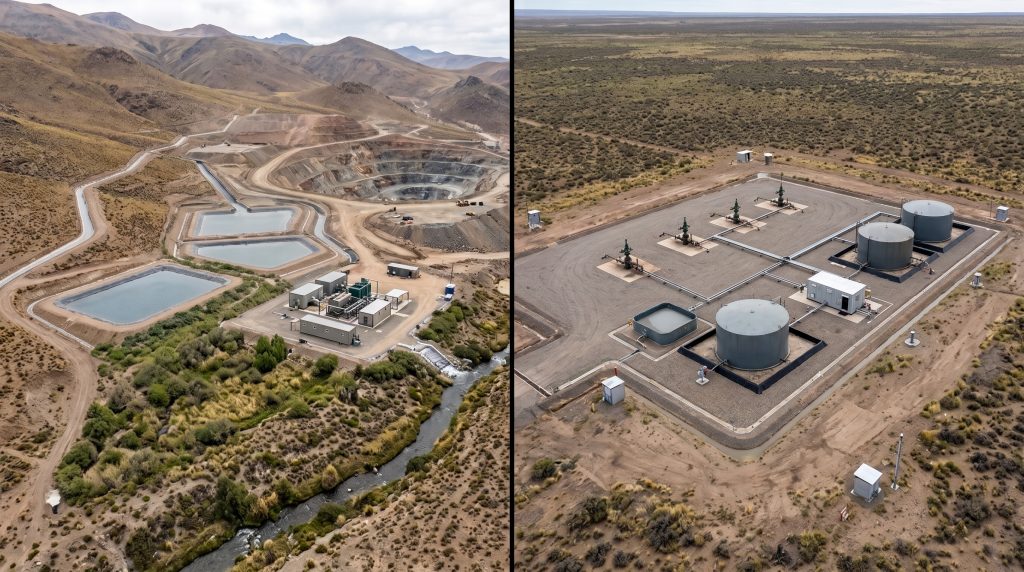
Prompt IA: AI image prompt: Professional aerial photograph of an open-pit mining operation in an arid Andean landscape in Argentina, with visible water containment ponds and tailings impoundments, surrounded by rocky terrain and mountains. The scene emphasizes the industrial scale of water management infrastructure. Natural lighting, high resolution, photorealistic style.
Alt text: Aerial view of mining operation with water containment infrastructure illustrating Argentina’s water environmental regulations for mining
Nombre de archivo sugerido: argentina-mining-water-environmental-regulations-aerial.jpg
Título sugerido: Mining Water Management Infrastructure – Argentina Environmental Compliance
Argentina’s Legal Framework for Water in Extractive Industries
Argentina operates under a federalized water governance model. Under Article 124 of the National Constitution, the provinces hold original ownership of their natural resources, including water. This means that while national-level laws establish baseline standards, each province has the authority to impose additional — and often stricter — requirements.
At the national level, the most relevant instruments include:
- General Environment Law No. 25,675: Establishes minimum environmental protection standards applicable to all productive activities, including requirements for Environmental Impact Assessments (EIA) that must address hydrological impact.
- Water Law No. 13,577 and its amendments: Governs potable water and sanitation infrastructure at the national level.
- Law No. 24,051 on Hazardous Waste: Regulates the handling and disposal of liquid and solid waste generated by extractive industries, with direct implications for water contamination prevention.
- Law No. 25,688 on Water Regime: Defines minimum standards for water preservation, use, and rational exploitation — critically relevant for industries with high water consumption such as mining and oil and gas operations.
- Environmental Mining Code (Law No. 24,196 and amendments): Specifically addresses environmental obligations for mining companies, including water protection, pit dewatering management, and acid mine drainage control.
In the hydrocarbon sector, Decree No. 1,172/93 and successive regulations from IRAM, IAPG, and the national and provincial energy secretariats establish technical and environmental standards for drilling, production, and transport operations, all of which carry significant hydrological implications — from spill prevention to produced water management.
Provincial Jurisdiction: Where Compliance Gets Complex
Because provinces control their own natural resources, industrial companies must align with the specific environmental authority and water code of each jurisdiction where they operate. Key mining provinces such as San Juan, Catamarca, Mendoza, Jujuy, and Santa Cruz each maintain their own environmental agencies with distinct requirements for:
- Water use permits and concessions (groundwater extraction, surface diversion).
- Effluent discharge standards into watercourses and groundwater bodies.
- Hydrological impact studies as prerequisites for EIA approval.
- Baseline hydrology assessments before project development begins.
- Post-closure monitoring plans for water bodies affected by operations.
In Patagonian provinces where hydrocarbon extraction is concentrated — particularly Neuquén, Río Negro, and Chubut — provincial environmental secretariats require detailed hydrogeological studies for unconventional extraction projects (including hydraulic fracturing), addressing potential impacts on both surface and subsurface water systems.
Understanding hydrological risk at the watershed level is essential when preparing documentation for provincial authorities. A rigorous risk assessment is often the decisive factor in whether an EIA is approved on the first submission or returned for additional studies.
Prompt IA: AI image prompt: A hydrological engineer in a hard hat and safety vest reviewing technical maps and hydrological study documents at a field station near a river in a Patagonian landscape. A laptop showing watershed modeling software is open on a portable work table. Professional, photorealistic, natural outdoor lighting.
Alt text: Hydrological engineer reviewing watershed study documents for mining environmental compliance in Argentina
Nombre de archivo sugerido: hydrological-study-mining-argentina-field-engineer.jpg
Título sugerido: Field Engineer Conducting Hydrological Study for Mining Compliance
Key Technical Studies Required for Regulatory Compliance
Meeting Argentina’s water environmental regulations for mining and hydrocarbons demands more than legal awareness — it requires technically defensible hydrological and hydraulic engineering studies. Regulatory authorities increasingly scrutinize the quality and methodology behind submitted documentation. The most commonly required technical deliverables include:
Hydrological Impact Studies
These studies quantify how a proposed project will alter natural water flows, runoff patterns, groundwater recharge, and watershed equilibrium. They form the backbone of any EIA’s water chapter. A well-structured hydrological impact study identifies potential risks before construction begins and proposes mitigation measures that satisfy both national minimums and provincial requirements. Learn more about the scope of these assessments in our overview of hydrological studies for efficient water management.
Flood Risk Analysis and Drainage Design
Industrial facilities located in or near floodplains — common in Andean mining districts and Patagonian river basins — must demonstrate that their infrastructure does not increase flood risk for downstream communities or ecosystems. This includes the design of stormwater drainage systems, containment ponds, and overflow structures. Our team provides detailed flood risk analysis tailored to the operational and regulatory context of each project.
Watershed and Basin Studies
For large-scale mining or hydrocarbon projects affecting significant catchment areas, basin-level studies are required to document the pre-operational hydrological baseline and model post-project scenarios. These studies support both EIA documentation and long-term environmental monitoring programs. Explore our dedicated watershed study services for more detail on methodology and deliverables.
Hydraulic Modeling for Infrastructure Design
Regulatory compliance often extends to the hydraulic design of water management infrastructure within the project footprint — tailings dams, process water circuits, mine dewatering systems, and produced water injection wells. Numerical hydraulic modeling ensures that these systems perform within the parameters established by environmental permits and do not generate unacceptable impacts on receiving water bodies. Our engineering consultancy for flood management applies these same modeling principles to industrial water infrastructure.
Prompt IA: AI image prompt: Close-up of a professional engineering office desk with printed hydraulic modeling reports, a computer screen displaying HEC-RAS river flow simulation results, and regulatory compliance checklists. Argentine regulatory documents visible in the background. Clean, professional, photorealistic style with warm office lighting.
Alt text: Hydraulic modeling and regulatory compliance documentation for Argentina water environmental regulations in mining and hydrocarbons
Nombre de archivo sugerido: hydraulic-modeling-regulatory-compliance-argentina-hydrocarbons.jpg
Título sugerido: Hydraulic Modeling and Compliance Documentation for Extractive Industries
Strategic Value of Early Regulatory Engagement
One of the most costly mistakes industrial companies make is treating environmental water compliance as a late-stage permitting exercise. In Argentina’s extractive sector, environmental authorities at both national and provincial levels are increasing technical scrutiny and extending review timelines for projects that submit incomplete or methodologically weak documentation.
Engaging specialized hydrological and hydraulic engineering consultants at the pre-feasibility and feasibility stages delivers measurable advantages:
- Early identification of hydrological constraints that may affect project design or site selection.
- Robust baseline data collection that withstands regulatory review and legal challenge.
- Faster EIA approval cycles due to higher-quality technical submissions.
- Reduced risk of costly post-approval modifications required by regulators.
- Stronger positioning in community and stakeholder consultation processes, where water issues are often the most contentious.
Argentina’s evolving regulatory landscape — shaped by increasing water scarcity concerns, glacier protection debates, and growing environmental litigation — makes proactive compliance not just advisable but strategically essential for companies with long-term operational horizons in the mining and hydrocarbon sectors.
How EHMH Group Supports Compliance in Extractive Industries
EHMH Group provides specialized hydrological and hydraulic engineering services to industrial and infrastructure companies operating across Argentina and Latin America. Our work covers the full spectrum of technical studies required under Argentina’s water environmental regulations for mining and hydrocarbons — from pre-project baseline assessments and hydrological impact studies to hydraulic modeling, drainage design, and post-closure monitoring support.
Our team works directly with environmental and permitting teams, EIA consultants, and legal advisors to deliver technically rigorous, regulatory-ready documentation that stands up to scrutiny from national and provincial environmental authorities. We understand that for companies in the extractive sector, every day of permitting delay has a direct cost — and our work is structured to minimize that risk.
If your company is preparing an environmental impact assessment, responding to a regulatory observation, or planning a new project in a water-sensitive area, our team is ready to support you. Contact EHMH Group today to discuss your project’s hydrological and hydraulic engineering requirements and find out how we can help you meet Argentina’s water environmental regulations efficiently and effectively.