
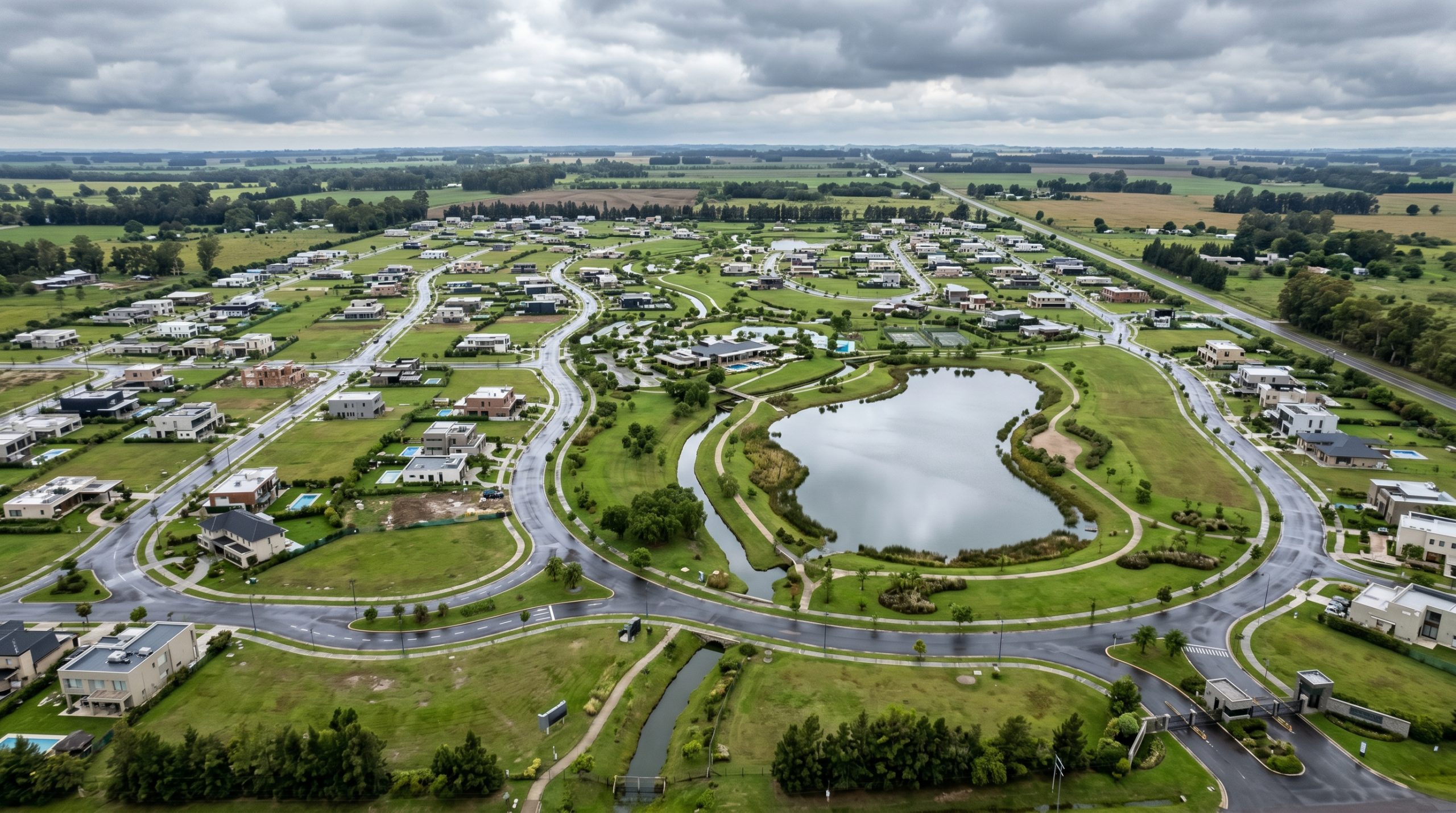
Technical consulting to resolve water supply, sewer, stormwater, and flooding issues in residential communities, private neighborhoods, and real estate projects
Industrial Hydraulic Diagnostics: Technical Assessment for Plants, Parks, and Production Facilities
Hydraulic diagnostics are not exclusive to residential developments. Industrial facilities — manufacturing plants, logistics parks, port terminals, mining operations, and production sites — face water-related challenges of far greater operational complexity, with direct economic consequences when systems fail.
In industrial environments, a deficient hydraulic system can cause production shutdowns due to flooding, contamination of stormwater effluents, damage to critical infrastructure, and regulatory sanctions for environmental non-compliance. For this reason, industrial hydraulic diagnostics require a specific technical approach that addresses:
- Stormwater absorption and drainage capacity for design rainfall events across the site.
- Separation and treatment of industrial effluents from stormwater networks.
- Vulnerability of critical equipment and processes to internal flooding.
- Compliance with current environmental regulations governing water discharge and management.
- Hydraulic capacity of existing networks in the context of facility expansions or changes in land use.
At EHMH Group, we carry out technical diagnostics for industrial facilities of all types, combining field surveys, hydraulic modeling, and operational water risk analysis. The output is an executive report with prioritized findings and actionable recommendations for technical teams and company management.
If your plant or facility has experienced recurring flooding, if you are planning an expansion, or if you need to validate the existing hydraulic design, learn how we work with extractive and production-sector companies.
At EHMH, we conduct hydraulic and hydrological diagnostics for urban developments, private communities, gated neighborhoods, residential complexes, subdivisions, industrial parks, and real estate projects experiencing issues with drainage, water supply networks, sewer systems, pumping stations, internal lakes, or flooding.
Our work enables clients to identify the true root cause of a problem, evaluate technical alternatives, and define a clear action plan before commissioning works, engaging contractors, or approving significant capital expenditure.
We support property managers, board committees, developers, and technical teams in making professionally grounded decisions — reducing risk, unnecessary costs, and operational conflicts.
When Should You Request a Hydraulic Diagnostic?
Whenever there is recurring flooding, sewer overflows, pump failures, conflicting contractor proposals, or uncertainty about stormwater, sewer, or water supply works. EHMH provides an independent technical assessment to identify root causes, prioritize actions, and define next steps before any capital is committed.
Before investing in construction works, it is worth confirming that the proposed solution actually addresses the real cause of the problem.
Signs That Your System Needs a Technical Evaluation
- Internal roads that flood during moderate rainfall events.
- Sewer manholes that overflow.
- Pumps running continuously or failing repeatedly.
- Persistent odors, blockages, or resident complaints.
- Lakes or reservoirs with water levels that are difficult to control.
- Construction quotes that are hard to compare or evaluate.
- Works already carried out that have not resolved the problem.
The EHMH Difference
Environmental and Hydraulic Regulations Applicable to Industrial Facilities in Argentina
Regulatory compliance is one of the primary drivers that leads industrial companies to commission a hydraulic diagnostic. In Argentina, water management on productive sites is governed by an overlapping framework of national, provincial, and municipal regulations that every company must understand and demonstrate adherence to before regulatory authorities.
Relevant Regulatory Framework
- General Environment Law No. 25.675 and its prevention and precautionary principles applicable to discharges and effluents.
- Industrial Waste Law No. 25.612 regarding stormwater contamination through the transport of hazardous substances.
- Provincial regulations from ACUMAR, OPDS, and ADA (Buenos Aires Province) and equivalent bodies in other jurisdictions, which govern discharge limits and water retention capacity requirements.
- Municipal drainage ordinances that may require maximum runoff coefficients and detention reservoirs on large-area sites.
The Diagnostic as a Compliance Instrument
A technical hydraulic diagnostic report prepared by an independent consultancy carries weight before regulatory authorities as evidence of due diligence in water management. It is also a requirement in environmental certification processes (ISO 14001) and in due diligence reviews for the acquisition or permitting of industrial sites.
EHMH Group produces technical reports with the methodological rigor required by regulatory bodies, integrating hydrological, hydraulic, and environmental criteria into a single executive document. To learn more about our approach, visit our hydrology for industry section or read our article on the importance of hydraulic, sewer, and stormwater studies.
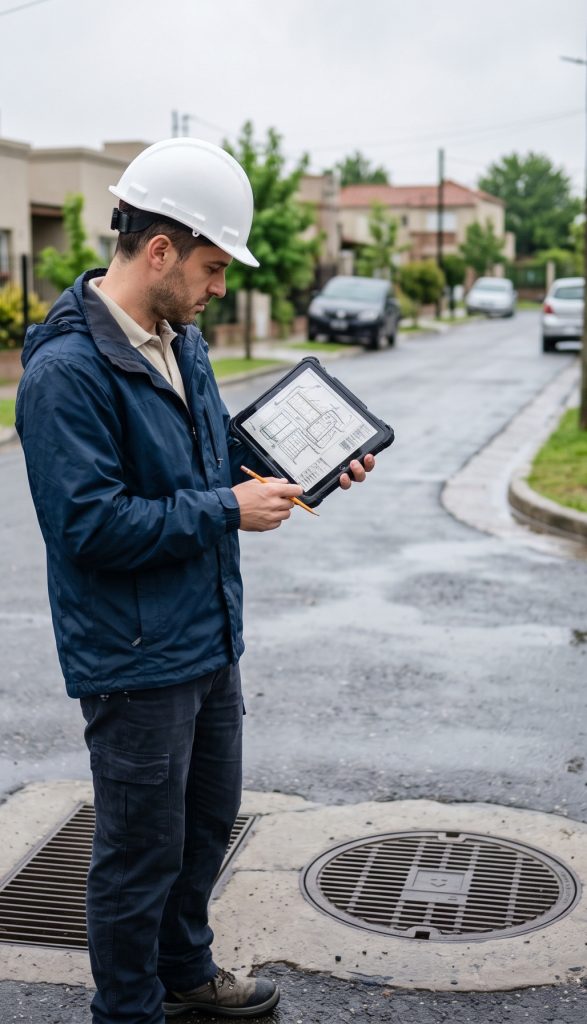
Technical Expertise and Practical Insight
We combine hands-on experience in sanitary infrastructure, technical planning, water supply, sewer, stormwater networks, and real-system operations with strong hydraulic and hydrological analysis capabilities.
Modeling and Field Judgment
We integrate calculation tools, mathematical models, and technical analysis with practical on-site surveys — avoiding purely theoretical diagnostics or generic, one-size-fits-all solutions.
Independence from Contractors and Suppliers
Our role is to help clients understand the problem and make technically informed decisions. We do not sell construction works or equipment, which allows us to evaluate alternatives objectively and without conflicts of interest.
Clear Reports That Enable Decisions
The diagnostic goes beyond a dense technical document. Our goal is for property managers, board members, developers, and technical teams to clearly understand the problem and confidently determine the next steps.
Preventive Approach
A thorough diagnostic helps avoid misdirected investments, oversized works, partial fixes, and recurring conflicts with residents and property owners.
Common Problems We Analyze
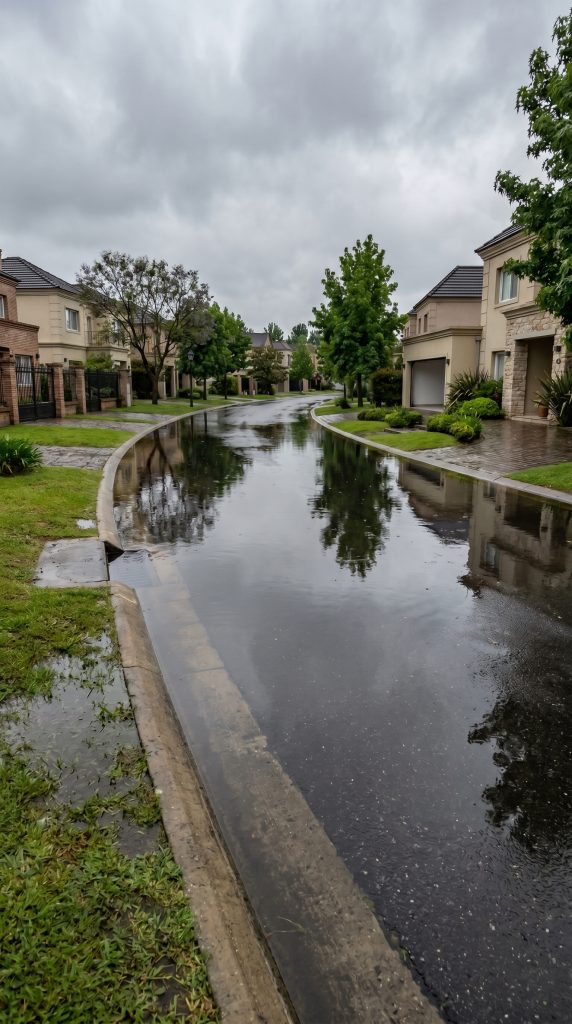
Internal Flooding and Waterlogging
We assess areas with water accumulation, flooded internal roads, affected lots, undersized drainage channels, blocked inlets, inadequate slopes, or stormwater systems that fail to perform adequately during heavy rainfall events.
Undersized or Incorrectly Connected Stormwater Networks
We analyze pipes, manholes, channels, culverts, inlets, detention basins, lakes, and outfall points to verify whether the system has sufficient capacity and whether the hydraulic operation is adequate.
Sewer Problems and Overflows
We review internal sewer networks, manholes, pipe grades, pumping stations, stormwater infiltration, recurring blockages, odors, and operational failures that may compromise the sanitary performance of the development.
Water Supply Networks and Pumping Stations
We evaluate water distribution systems, pumps, pressures, losses, critical points, tanks, cisterns, rising mains, and operating conditions to detect design flaws, maintenance deficiencies, or capacity limitations.
Internal Lakes, Reservoirs, and Water Bodies
We analyze the hydraulic role of internal lakes, reservoirs, channels, outfalls, and control structures to determine whether they are adequately fulfilling their intended function of attenuation, storage, or conveyance.
Conflicting Proposals and Contractor Quotes
Developments often receive multiple construction proposals without a clear basis for comparison. EHMH can review quotes, compare alternatives, and issue an independent technical recommendation.
Who We Work With
Private Community and Residential Development Administrators
We provide technical support to help understand recurring problems, respond to resident complaints, and prioritize capital investment in internal infrastructure.
Board of Directors and Technical Committees
We prepare clear, defensible reports to facilitate decision-making, establish priorities, and reduce disputes among property owners, management, and contractors.
Real Estate Developers
We support the hydraulic and hydrological analysis of new developments, expansion phases, future stages, feasibility studies, and stormwater, sewer, and flow regulation systems.
Architecture, Engineering, and Urban Planning Firms
We act as a specialized hydraulics and hydrology resource for urban, residential, industrial, or mixed-use projects.
Industrial Parks and Logistics Facilities
We diagnose runoff, drainage, internal network, pumping, reservoir, and discharge issues across large impervious-surface sites.
Specific Hydraulic Risks in Industrial and Logistics Facilities
Industrial facilities present a hydraulic configuration substantially different from that of a residential development. Impervious surface coverage is greater, heavy vehicle traffic modifies soil infiltration, and the presence of water-sensitive materials or substances exponentially increases the cost of a flooding event.
Common Risk Factors in Industrial Sites
- Maneuvering yards and ground-level warehouses that concentrate runoff with no controlled outlet.
- Undersized stormwater networks relative to the actual imperviousness of the site, designed using outdated criteria.
- Mixing of industrial effluents with stormwater, creating environmental liabilities and exposure to regulatory fines.
- Electrical and control equipment located in low-lying areas, vulnerable to even minimal water depths.
- Unplanned expansions that alter the original hydrological behavior of the site without updating the drainage infrastructure.
Operational and Legal Consequences
Flooding at an industrial facility is not simply a maintenance issue: it can mean days of production downtime, damage to high-value machinery, civil liability toward third parties, and environmental sanctions. Water risk analysis conducted in advance is the technical tool that allows these scenarios to be anticipated before they occur.
At EHMH Group, we identify the critical points in your facility’s hydraulic system, quantify risk under different rainfall scenarios, and propose solutions sized for your plant’s actual operational conditions. We also recommend our hydrological studies for companies as a complement to the diagnostic process.




What a Hydraulic Diagnostic Includes
Background Review
We analyze available drawings, existing project documentation, rainfall records, complaint histories, photographs, quotes, technical reports, construction records, and operational documentation.
On-Site Technical Visit
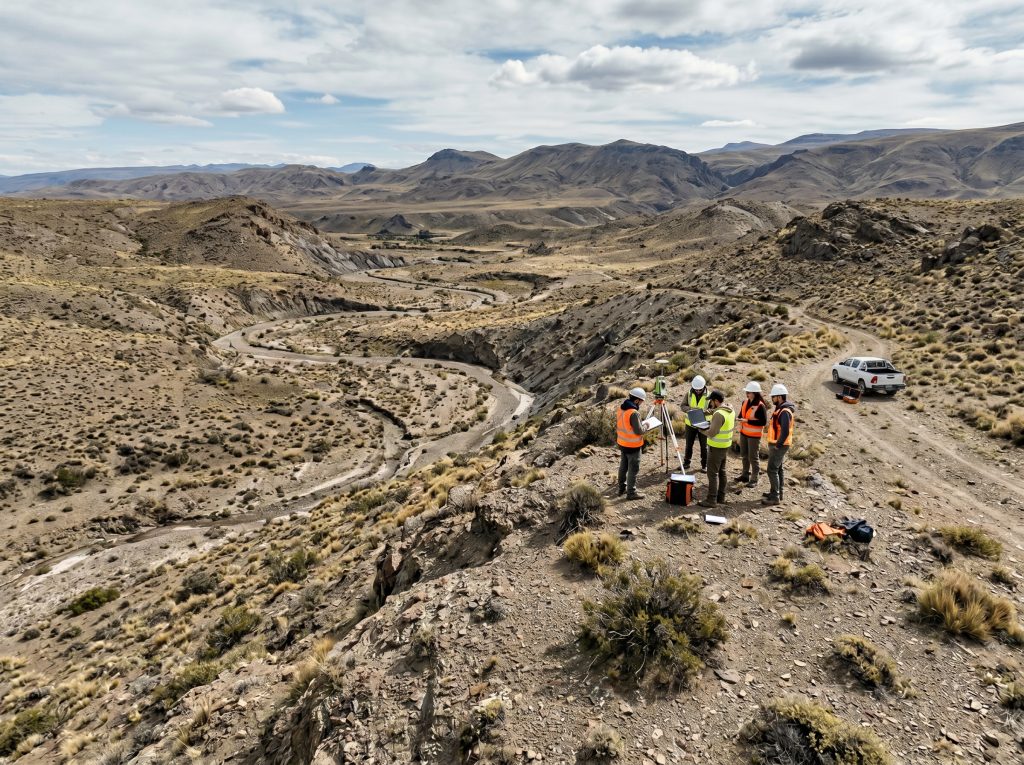
We conduct a technical walkthrough to identify critical points, actual runoff conditions, and the operational status of manholes, inlets, drainage channels, pumping stations, lakes, outfalls, and affected areas.
Interviews with Management and Maintenance Staff
We speak with the people who operate the system to understand the history of failures, frequency of events, complaints received, interventions carried out, and current issues.
Root Cause Diagnosis
The objective is not merely to describe the symptom, but to identify why it occurs: insufficient capacity, poor design, inadequate maintenance, improper grades, unauthorized connections, blockages, incorrect operation, or the need for complementary works.
Evaluation of Alternatives
We propose solution alternatives ranging from immediate operational measures to larger-scale construction works, prioritizing by impact, urgency, cost, feasibility, and risk.
Review of Existing Quotes
When the client already holds contractor proposals, we assess whether the proposed solutions are technically sound, comparable, and consistent with the identified problem.
Executive Technical Report
We deliver a clear, structured, and actionable document for management, board members, developers, or technical teams — covering diagnosis, conclusions, priorities, and recommended next steps.
Deliverables

Technical Diagnostic Report
A document covering problem description, survey findings, technical analysis, critical points, probable causes, and recommendations.
Priority Matrix
Classification of actions by urgency, impact, complexity, estimated cost, and operational risk.
Immediate Action Recommendations
Short-term measures to reduce risk, improve operations, or contain problems while definitive solutions are being evaluated.
Phased Works and Improvement Plan
Where appropriate, we propose a sequenced intervention plan to organize investment and avoid isolated, reactive decisions.
Technical Review of Contractor Quotes
Comparative analysis of received proposals, with observations on scope, omissions, technical criteria, quantities, and fit to the identified problem.
Results Presentation Meeting
We present findings to the client, management team, board, or technical staff — explaining conclusions and addressing questions.
Working Methodology
1. Initial Consultation
The client describes the problem, location, available background information, and level of urgency.
2. Preliminary Review
We request drawings, photos, videos, quotes, complaint records, or any documentation that helps us understand the situation.
3. Scope Proposal
We define the diagnostic scope, required level of detail, deliverables, timeline, and professional fees.
4. Technical Survey
We carry out the site visit and collect technical, operational, and documentary information.
5. Hydraulic and Hydrological Analysis
We assess system behavior, identify probable causes, and where appropriate, apply calculation tools or hydraulic modeling.
6. Report and Recommendations
We deliver a clear diagnostic with solution alternatives and prioritized action steps.
7. Ongoing Advisory Support
We can continue as technical advisors to review quotes, support tender processes, evaluate contractors, or oversee the implementation of improvements.
Related Services
Stormwater System Diagnostics
Assessment of drainage networks, inlets, manholes, pipes, channels, detention basins, lakes, and outfall points.
Sewer Network Diagnostics
Analysis of pipe grades, manholes, blockages, pumping stations, unauthorized inflows, and operational failures.
Water Supply Network Diagnostics
Evaluation of pressures, flow rates, pumps, cisterns, tanks, rising mains, and internal distribution systems.
Hydrological Studies
Catchment analysis, hydrology for industry, design rainfall, runoff, flow rates, water risk, and discharge conditions.
Hydraulic Models
Simulation of networks, channels, conduits, drainage structures, lakes, reservoirs, and operating scenarios.
Project and Quote Review
Technical evaluation of solutions proposed by third parties before investment decisions are made.
Monthly Technical Advisory
Ongoing support for property managers, developers, or board committees requiring external specialist assistance.

Typical Cases Where We Can Help
Typical Hydraulic Diagnostic Scenarios in Industrial Contexts
The following are real-world scenarios that lead industrial companies to commission an independent technical hydraulic diagnostic. If your company recognizes itself in any of these cases, your hydraulic system likely warrants a professional evaluation.
Production Plant with Recurring Flooding During Rainfall Season
The site floods during moderate-intensity storms, affecting loading yards, warehouses, or process areas. The existing stormwater system was designed years ago and does not account for the current level of imperviousness or the more frequent extreme rainfall events associated with climate change. Learn more about post-rainfall flooding in highly impervious developments.
Industrial Park Planning a New Expansion Phase
The addition of new warehouses, yards, or infrastructure alters the hydrological balance of the site. Before the executive project is approved, it is essential to verify that the existing drainage network has the capacity to handle the increased runoff. A prior diagnostic avoids costly corrective works once the expansion has been built.
Company Facing Observations from Environmental Authorities
A provincial regulatory body has identified non-compliant discharges or deficiencies in the separation of stormwater and industrial effluents. The hydraulic diagnostic is the first step toward developing a technical remediation plan that allows the company to regularize its situation before the regulatory authority.
Acquisition or Lease of an Industrial Site
Before committing resources to a new facility, companies need to understand the actual condition of the hydraulic infrastructure: drainage capacity, network condition, existence of environmental liabilities, and regulatory compliance. A prior technical diagnostic is part of responsible due diligence. For further context on the scope of these studies, refer to our article on watershed studies applied to productive projects.
The Development Experiences Recurring Flooding During Heavy Rainfall
We investigate whether the problem stems from insufficient stormwater capacity, inadequate slopes, blockages, restricted outfalls, poorly operated lakes, or external interference.
Recurring Sewer Overflows
We analyze whether the cause lies in the network itself, pumping stations, blockages, unauthorized stormwater inflows, or lack of maintenance.
Multiple Quotes with No Clear Basis for Selection
We technically compare the alternatives, identify omissions, and help determine which proposal best addresses the actual problem.
Works Were Carried Out, But the Problem Persists
We assess whether the works addressed the symptom rather than the cause, whether they were undersized, or whether other parts of the system are conditioning overall performance.
The Development Needs to Plan Works in Phases
We organize priorities so that improvements can be implemented progressively, avoiding isolated investments or emergency-driven decisions.
Service Areas
We work across Buenos Aires, the Greater Buenos Aires Metropolitan Area (AMBA), Zona Norte, Escobar, Pilar, Tigre, Nordelta, Benavídez, Ingeniero Maschwitz, Campana, Zárate, Luján, General Rodríguez, and other locations throughout the country.
We also participate in specialized projects in other provinces when the technical scope warrants it, including hydrological studies, water risk and flash flood risk assessments, fluvial projects, and larger-scale urban developments.
Frequently Asked Questions
Is a diagnostic useful if we don’t yet know what the problem is?
Yes. That is precisely the purpose of the diagnostic: to organize the available information, identify probable causes, and determine what studies, works, or actions are appropriate.
Do you only work with gated communities?
No. We work with urban developments, private communities, residential complexes, subdivisions, industrial parks, logistics facilities, developers, and special-purpose projects. Gated communities are one of the most common cases, but they are far from the only one.
Can you review contractor proposals?
Yes. We can analyze both technical and commercial proposals, compare scopes, identify omissions, and assess whether the proposed solution addresses the identified problem.
Do you produce detailed engineering designs?
Yes. Depending on the case, we can progress from the diagnostic to more detailed studies, hydraulic modeling, preliminary designs, detailed engineering designs, or technical support during implementation.
Do you visit the site?
Yes. In most cases, the on-site technical visit is essential to understanding how the system actually operates and to verifying that documentation reflects real field conditions.
Can the report be presented to a board or management committee?
Yes. The report is structured so that it can be understood by both technical and non-technical profiles, facilitating decision-making and investment prioritization.
Can you work with incomplete information?
Yes. It is common for developments not to have fully updated documentation. In those cases, the diagnostic also helps identify what information is missing and what additional surveys may be needed.
Request an Initial Diagnostic
If your development, community, or facility is experiencing flooding, stormwater drainage issues, sewer problems, water supply failures, pump malfunctions, or problems with internal lakes, we can carry out an initial case assessment.
Send us a description of the problem along with the location, photos, drawings, or any available background information, and we will coordinate an initial technical review.
Request an initial assessment
Before investing in construction works, it is worth confirming that the proposed solution actually addresses the real cause of the problem.