
Post-rain flooding in residential urban developments has become one of the most significant technical, economic, and legal challenges facing real estate developers, construction firms, and urban infrastructure operators. As urbanization projects expand over land that historically absorbed rainfall, soil impermeabilization dramatically increases surface runoff, overwhelming undersized — or entirely absent — drainage systems. The result is flooding that damages infrastructure, triggers contractual liabilities, and threatens the commercial viability of entire developments. Understanding the structural causes of this phenomenon and adopting hydraulic engineering solutions from the earliest project stages is now a strategic necessity for any company operating in this sector.
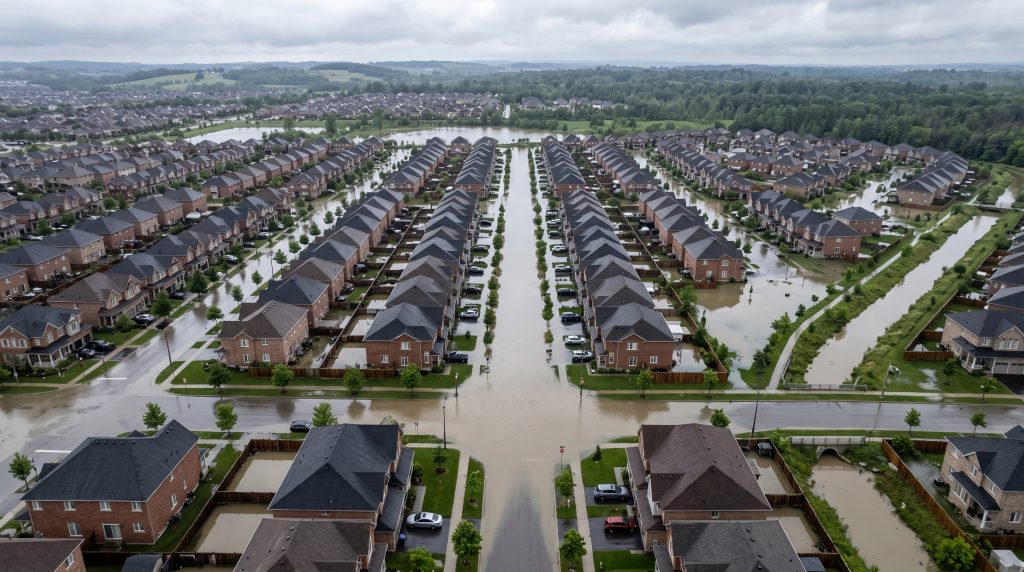
Why Are Residential Urban Developments Vulnerable to Flooding?
Urbanization fundamentally transforms the hydrological behavior of a catchment. Before human intervention, natural soil infiltrates, retains, and evaporates a significant proportion of rainfall. Once that soil is covered by pavement, rooftops, sidewalks, and structures, surface runoff can increase by 40% to 80% relative to natural conditions, depending on development density and pre-existing soil type.
Compounding factors frequently encountered in residential projects include:
- Undersized stormwater drainage design: systems are dimensioned using insufficient return periods or without accounting for future growth of the contributing catchment.
- Absence of prior hydrological studies: many developments are approved without a rigorous analysis of how the site will respond to design storm events.
- Alteration of natural grades and slopes: earthworks change original flow paths, creating unplanned accumulation points.
- No retention infrastructure: retention ponds, infiltration trenches, and permeable pavements that would attenuate peak flows are simply not incorporated.
- Climate change: the increasing frequency and intensity of extreme precipitation events exceeds the capacity of systems designed using historical climate parameters that are now outdated.
To gain a deeper understanding of the challenges of hydraulic management in urban areas, it is essential to recognize that each residential development creates a new artificial sub-catchment with its own hydrological behavior — one that must be modeled and actively managed.
Technical and Economic Consequences for Developers
Post-rain flooding in residential urban developments is not merely a habitability issue. For the companies involved in developing, building, and operating these projects, the consequences have significant technical, economic, and legal dimensions:
- Damage to internal infrastructure: pavements, buried utility networks, retaining walls, and green spaces can deteriorate rapidly under repeated flooding events.
- Civil and contractual liability: in many jurisdictions, developers are legally required to guarantee minimum stormwater drainage conditions. Flooding incidents can result in legal claims and contractual penalties.
- Impact on brand image and commercial value: a development with a history of flooding loses market competitiveness, depressing sale prices and slowing absorption rates.
- Rehabilitation costs: retrofitting an already-built drainage system is significantly more expensive than designing it correctly from the outset.
A hydraulic diagnostic for urban developments carried out at the preliminary design stage identifies vulnerabilities before they translate into actual losses, optimizing both the design and the investment in drainage infrastructure.
Engineering Tools to Prevent Flooding in Residential Developments
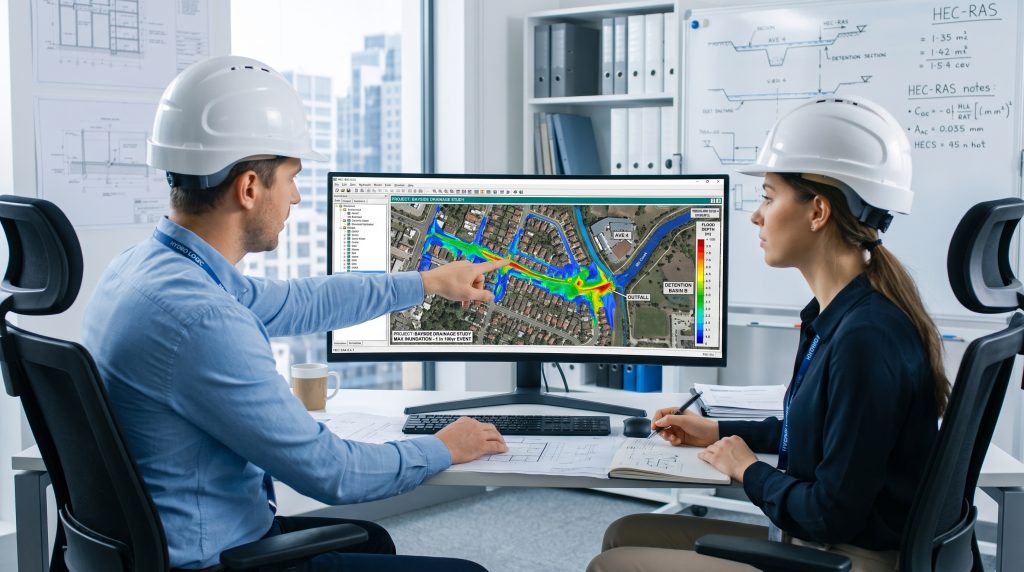
Hydraulic and hydrological engineering provides a comprehensive set of analytical and design tools to rigorously address post-rain flooding in residential urban developments. The most relevant include:
Hydrological and Hydraulic Modeling
Computational modeling simulates system behavior under various rainfall scenarios, identifies critical accumulation points, and evaluates the performance of proposed solutions before construction begins. Industry-standard tools such as HEC-HMS, SWMM, and HEC-RAS are widely used for this type of analysis.
Catchment Hydrological Studies
A complete hydrological study characterizes the catchment contributing to the project site, determines design flow rates for different return periods, and establishes boundary conditions for sizing drainage infrastructure. Hydrological studies are essential for efficient water management in any large-scale urban development.
Urban Stormwater Drainage System Design
The design of collector networks, inlets, gutters, conduits, and outfall structures must account not only for current development conditions but also for future urban growth and the effects of climate change on precipitation patterns. Incorporating green infrastructure — retention ponds, rain gardens, permeable pavements — complements conventional systems and improves the hydraulic resilience of the development.
Flood Risk Analysis
Flood risk analysis integrates the probability of extreme events with infrastructure vulnerability and potential consequences, enabling developers to prioritize investments and make informed decisions about the appropriate level of protection for each project.
The Role of Environmental and Urban Regulations in Flood Risk Management
In most Latin American countries, urban planning and environmental regulations require that new residential developments not increase outflow rates beyond pre-urbanization natural conditions. This principle — known as flow compensation — obliges developers to incorporate retention or infiltration works that offset the effects of impermeabilization.
However, formal regulatory compliance does not always guarantee the absence of problems. The quality of the baseline hydrological study, the correct interpretation of design criteria, and rigorous technical supervision during construction are all decisive factors in ensuring that the works perform as designed.
Understanding the water risk associated with each specific development site is the essential first step toward designing solutions that are technically sound, regulatory-compliant, and economically efficient. Skipping this early diagnostic stage is, in practice, simply deferring the cost of the problem to a later point — when intervention options are both more limited and more expensive.
Conclusion: Prevention as a Business Strategy
Post-rain flooding in residential urban developments is not inevitable. In the vast majority of cases, it is the predictable — and preventable — consequence of inadequate hydraulic planning. For developers, construction firms, and urban infrastructure operators, investing in rigorous hydrological studies, proper drainage design, and professional hydraulic modeling is not an overhead cost: it is a strategic decision that protects project value, reduces legal exposure, and ensures the development functions as intended throughout its service life.
At EHMH Group, we have the technical team and experience to support your company at every stage of this process — from initial diagnostic through design, modeling, and hydraulic works supervision. Contact us today to assess the water risk of your development and design the solutions you need.